2026

HSTM-Det: Hierarchical Timescale Alignment for UAV and Remote Sensing Object Detection

Yucheng Qiu, Zhanhao Liu#, He Wang (# corresponding author)

IEEE International Conference on Systems, Man, and Cybernetics (SMC 2026), CORE B, CCF C 2026

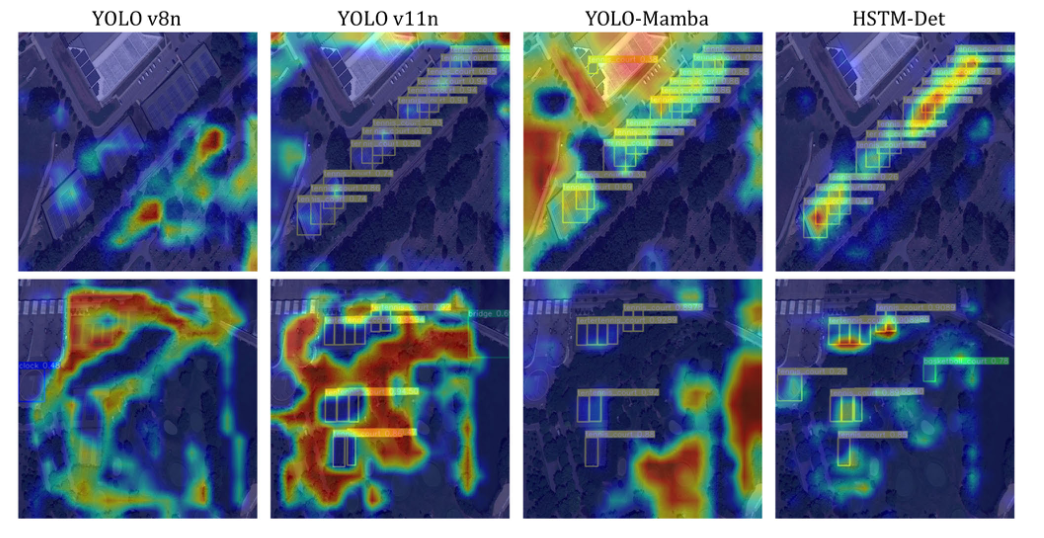
State Space Models (SSMs), notably Mamba, have emerged as promising backbones for visual detection due to their linear complexity and global receptive fields. However, existing SSM-based detectors typically employ a shared prop- agation step size ∆ across all pyramid levels, overlooking the inherent multi-scale temporal dynamics of visual features. This design induces a timescale mismatch: high-frequency details in shallow layers are over-smoothed, while deep semantic features suffer from insufficient contextual accumulation. Such mis- alignment is further amplified during neck fusion, particularly degrading performance in UAV and remote sensing scenarios where objects exhibit extreme scale variations and complex backgrounds. To address this, we propose the Hierarchical Timescale Modulation Detector (HSTM-Det), which explicitly reconstructs multi-scale state propagation via learning-based dynamic modulation. Our framework introduces three key components: (1) a Hierarchical Timescale Modulation (HSTM) module that generates level-specific step sizes ∆ conditioned on feature statistics, enabling adaptive state updates tailored to each pyramid level; (2) an Adaptive Routed Fusion Module (ARFM) paired with an HSTM-based Continuity Calibration (HSTM-CC) mechanism, which preserves timescale discrepan- cies through content-conditioned routing and post-fusion cali- bration in the neck; and (3) a Progressive Boundary Refinement (PBR) strategy that translates enhanced multi-scale represen- tations into precise localization. Extensive experiments on two challenging remote sensing benchmarks, NWPU VHR-10 and SIMD, validate the effectiveness of HSTM-Det. Specifically, our method improves YOLOv11n from 85.3/52.84 to 92.1/63.5 and from 86.9/49.78 to 93.4/56.0 in mAP@50/mAP@95, respectively, with merely 0.35M additional parameters and 0.6G extra FLOPs. These results demonstrate that hierarchical timescale alignment provides a principled and efficient solution to ad- vance lightweight SSM-based detectors for aerial and satellite imagery analysis.

HSTM-Det: Hierarchical Timescale Alignment for UAV and Remote Sensing Object Detection

Yucheng Qiu, Zhanhao Liu#, He Wang (# corresponding author)

IEEE International Conference on Systems, Man, and Cybernetics (SMC 2026), CORE B, CCF C 2026

State Space Models (SSMs), notably Mamba, have emerged as promising backbones for visual detection due to their linear complexity and global receptive fields. However, existing SSM-based detectors typically employ a shared prop- agation step size ∆ across all pyramid levels, overlooking the inherent multi-scale temporal dynamics of visual features. This design induces a timescale mismatch: high-frequency details in shallow layers are over-smoothed, while deep semantic features suffer from insufficient contextual accumulation. Such mis- alignment is further amplified during neck fusion, particularly degrading performance in UAV and remote sensing scenarios where objects exhibit extreme scale variations and complex backgrounds. To address this, we propose the Hierarchical Timescale Modulation Detector (HSTM-Det), which explicitly reconstructs multi-scale state propagation via learning-based dynamic modulation. Our framework introduces three key components: (1) a Hierarchical Timescale Modulation (HSTM) module that generates level-specific step sizes ∆ conditioned on feature statistics, enabling adaptive state updates tailored to each pyramid level; (2) an Adaptive Routed Fusion Module (ARFM) paired with an HSTM-based Continuity Calibration (HSTM-CC) mechanism, which preserves timescale discrepan- cies through content-conditioned routing and post-fusion cali- bration in the neck; and (3) a Progressive Boundary Refinement (PBR) strategy that translates enhanced multi-scale represen- tations into precise localization. Extensive experiments on two challenging remote sensing benchmarks, NWPU VHR-10 and SIMD, validate the effectiveness of HSTM-Det. Specifically, our method improves YOLOv11n from 85.3/52.84 to 92.1/63.5 and from 86.9/49.78 to 93.4/56.0 in mAP@50/mAP@95, respectively, with merely 0.35M additional parameters and 0.6G extra FLOPs. These results demonstrate that hierarchical timescale alignment provides a principled and efficient solution to ad- vance lightweight SSM-based detectors for aerial and satellite imagery analysis.

Efficient Hybrid Adapter for Thermal-Visible Tracking

He Wang

IEEE International Conference on Image Processing (ICIP 2026), CORE B, CCF C 2026

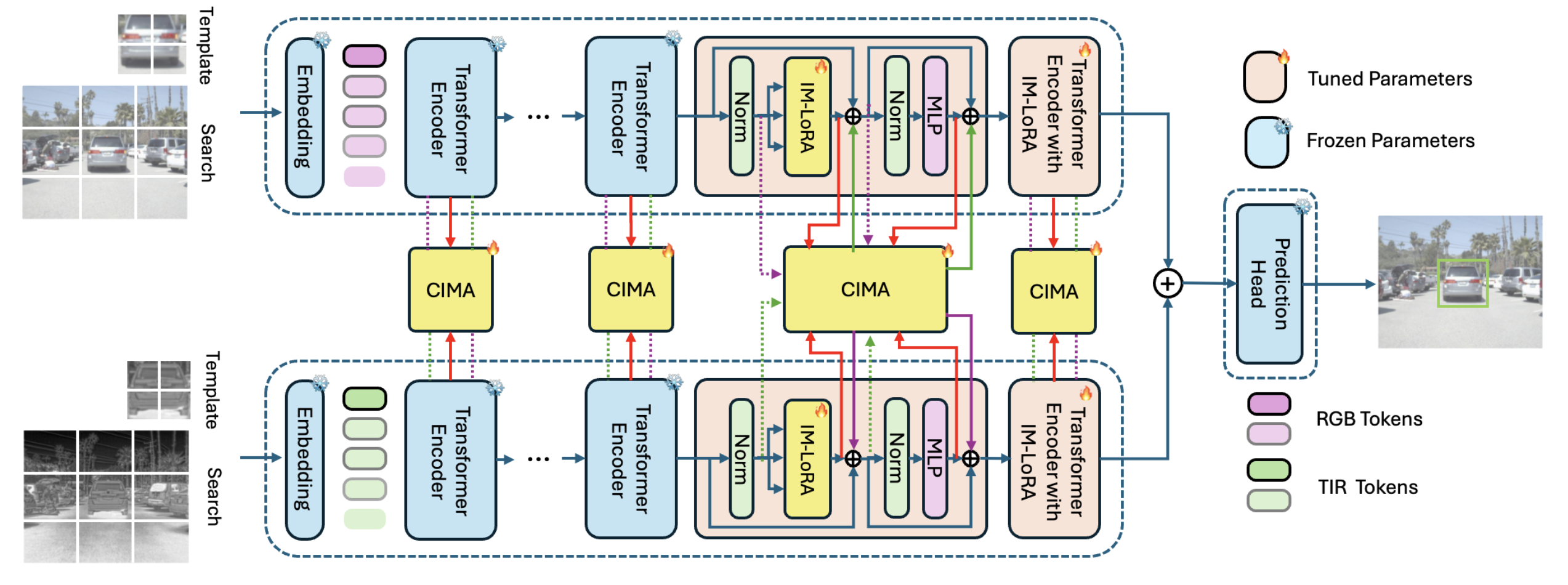
Hybrid Adapter Tracker (HAT) enhances RGB-T tracking by utilizing IM-LoRA for intra-modal alignment and CIMA for inter-modal fusion, achieving state-of-the-art results on LasHeR and RGBT234 datasets.

Efficient Hybrid Adapter for Thermal-Visible Tracking

He Wang

IEEE International Conference on Image Processing (ICIP 2026), CORE B, CCF C 2026

Hybrid Adapter Tracker (HAT) enhances RGB-T tracking by utilizing IM-LoRA for intra-modal alignment and CIMA for inter-modal fusion, achieving state-of-the-art results on LasHeR and RGBT234 datasets.